Coupling Polyolefin Conversion and Methanol Reduction for C9-C10 Alkylaromatic Production
Recently, under the supervision of Professor Zhen Fang, collaborated with Profs. Richard L. Smith (Tohoku Univ, Japan) and Janusz Kozinski (Lakehead Univ, Canada), PhD student Mr. Sheng-ren Li published a research article focusing on polyolefin conversion into C9-C10 Alkylaromatic in Angewandte Chemie International Edition (Q1; Impact factor: 17.6).
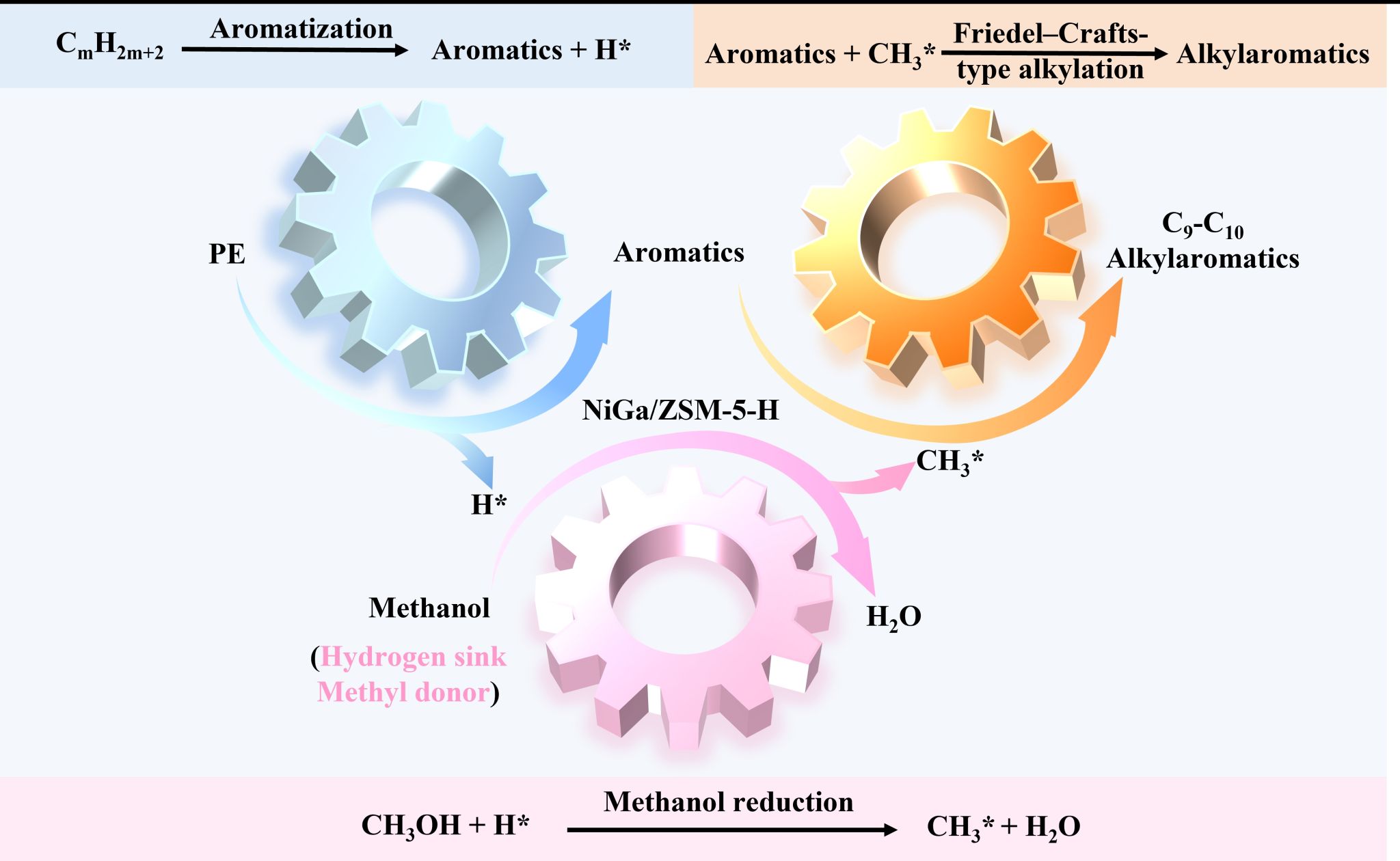
This work presents a strategy for integrating polyethylene (PE) aromatization and Friedel–Crafts-type alkylation reactions via methanol reduction for upgrading PE to 79.0 wt% liquid with 56.1 wt% aromatics at 280 °C, enabled by a bifunctional NiGa/ZSM-5-H catalyst. In the catalyst design, hierarchical ZSM-5-H promotes cracking of PE, while Ga serves not only as an active site for aromatization and alkylation, but also suppresses Ni⁰ formation by withdrawing electron density from Ni, ensuring that Ni2+ remains as the active catalytic site for methanol reduction. Hydrogen species derived from PE aromatization participate in methanol reduction, while methanol functions mainly as a hydrogen sink and methyl donor yet also releases some hydrogen under reaction conditions, allowing the PE aromatization and methanol reduction steps to be coupled. In the presence of hydrogen, methanol reduction generates methyl species that promote Friedel–Crafts-type alkylation, incorporating methyl groups into the alkyl substituents of aromatics and boosting C9-C10 alkylaromatics yields by more than 600%. By introducing 0.99 g/g methanol equivalent into the PE-catalyst reaction system, aromatic and C9-C10 alkylaromatics yields are more than double those without methanol. The strategy is applicable to upgrading of polyolefins and offers a practical route for industrial processing of plastic waste.
Results were accepted in Angewandte Chemie International Edition:
SR Li, RL. Smith, JA Kozinski, Zhen Fang*, Coupling Polyolefin Conversion and Methanol Reduction for C9-C10 Alkylaromatic Production, Angewandte Chemie International Edition, 2026, e5589662, https://doi.org/10.1002/anie.5589662.
聚烯烃转化与甲醇还原耦联生产C9-C10烷基芳烃Coupling Polyolefin Conversion and Methanol Reduction for C9-C10 Alkylaromatic Production
博士生李胜任Angew: 聚烯烃转化与甲醇还原耦联生产C9-C10烷基芳烃
最近,在方真教授的指导下,与日本东北大学Richard L. Smith教授和加拿大湖首大学Janusz Kozinski教授合作,博士生李胜任在《Angewandte Chemie International Edition》(Q1; Impact factor: 17.6) 上发表了一篇关于聚烯烃塑料升级制备高价值C9-C10烷基芳烃的研究性论文。这是李胜任同志一作发表关于液化的第3篇论文(此前在CEJ和RE已发表)。
该研究提出了一种通过甲醇还原将聚乙烯(PE)芳构化和傅克型烷基化反应相结合的策略,利用双功能NiGa/ZSM-5-H催化剂,在280 °C下将PE升级为含56.1 wt%芳烃的79.0 wt%液体。在催化剂设计中,分级结构的ZSM-5-H促进了PE的裂解,而Ga不仅作为芳构化和烷基化的活性位点,还通过从Ni中抽离电子密度来抑制Ni⁰的形成,从而确保Ni²⁺作为甲醇还原的活性催化位点。来自聚乙烯芳构化的氢物种参与甲醇还原反应,而甲醇主要作为氢源和甲基供体,但在反应条件下也会释放部分氢,从而使聚乙烯芳构化和甲醇还原步骤得以耦合。在氢气存在下,甲醇还原会生成甲基物种,这些物种能促进傅克型烷基化反应,将甲基引入芳香族化合物的烷基取代基中,并将 C9-C10烷基芳香族化合物的收率提高了 600% 以上。通过向PE催化剂反应体系中引入0.99 g/g当量的甲醇,芳烃和C9-C10烷基芳烃的收率是未添加甲醇时的两倍以上。该策略适用于聚烯烃的升级转化,并为塑料废弃物的工业处理提供了一条切实可行的途径。
结果发表在Angewandte Chemie International Edition:
SR Li, RL. Smith, JA Kozinski, Zhen Fang*, Coupling Polyolefin Conversion and Methanol Reduction for C9-C10 Alkylaromatic Production, Angewandte Chemie International Edition, 2026, e5589662, https://doi.org/10.1002/anie.5589662.