Conversion of Waste Polyolefins into Iso-Alkanes or Aromatics via Coupled Methanol Decomposition-Hydrocracking
Recently, under the supervision of Professor Zhen Fang, collaborated with Profs. Richard L. Smith (Tohoku Univ, Japan) and Janusz Kozinski (Lakehead Univ, Canada), PhD student Mr. Sheng-ren Li published a research article focusing on polyolefin conversion into iso-alkanes or aromatics in Chemical Engineering Journal (Q1; Impact factor: 12.5).
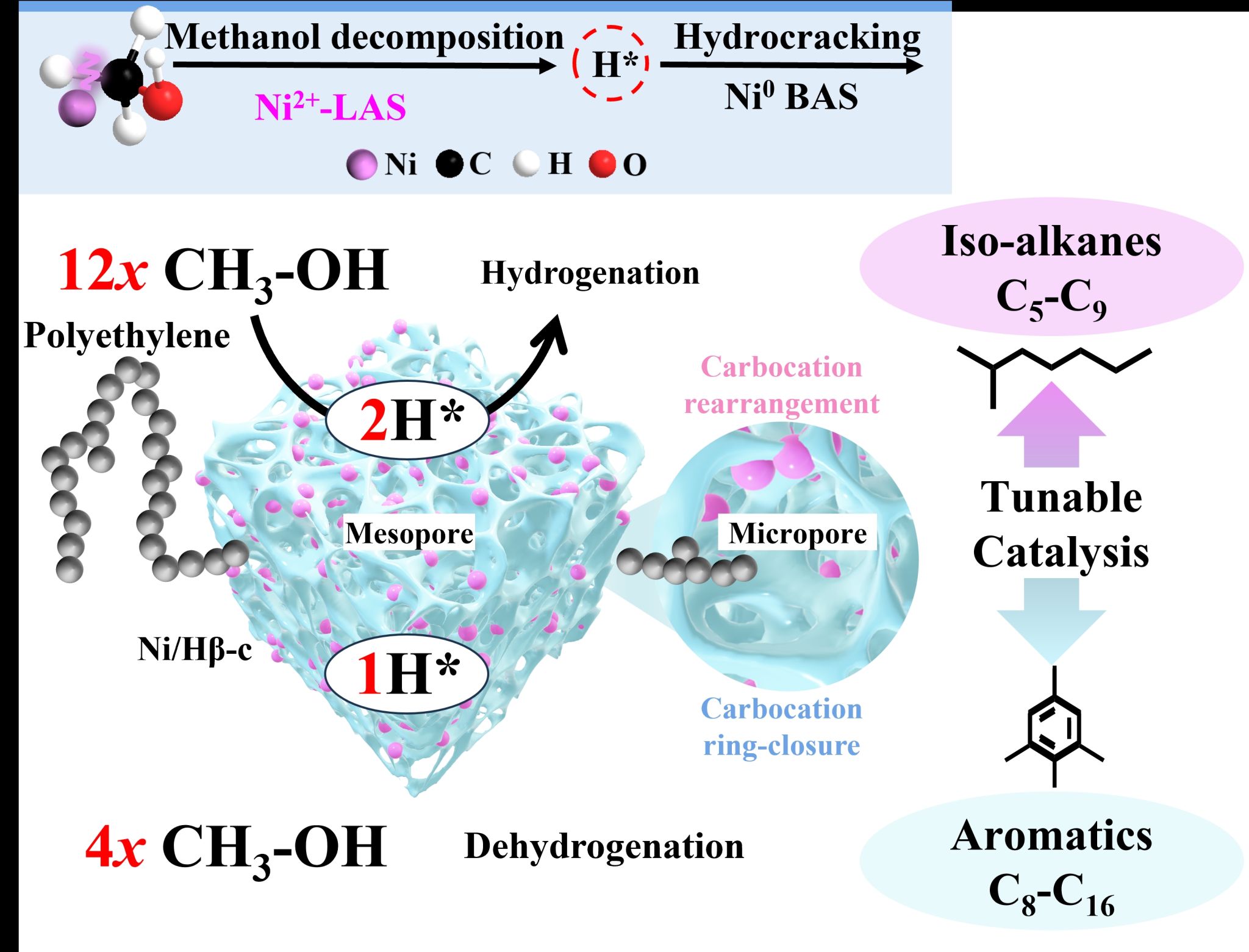
Herein, coupled methanol decomposition-hydrocracking of polyolefins over a hierarchical zeolite-supported nickel catalyst (Ni/Hβ-c; 10 wt% nano-scale Ni) converts polyethylene (PE) to either aromatic (H-lean environment) or iso-alkane (H-rich environment) liquid products. PE is converted into C5-C16 hydrocarbons (280 °C, 1 h) in methanol, affording 80 wt% yields and >8 g g-1cat h-1 productivities, higher than noble-metal catalysts in methanol, driven by hydrogen supply mode and accessible acid sites of Ni/Hβ-c. Hierarchical pores of Ni/Hβ-c promote transformation of waxes to liquid products; Ni0 sites catalyze methanol decomposition to generate hydrogen; Ni2+-associated Lewis acid sites facilitate hydrogen transfer to PE hydrocracking; accessible Brønsted acid sites enable C-C bond β-scission. Methanol primarily serves as a hydrogen mediator, continuously generating hydrogen that accelerates β‑scission to 71.4 mmol h-1, with rates remaining high even under external H2 (53.7 mmol h-1). Isotope-labeling experiments revealed distinct transfer pathways for methanol-derived hydrogen and carbon: hydrogen is incorporated into both aromatics and iso-alkanes, whereas carbon is incorporated exclusively into aromatic substituents via alkylation. The Ni/Hβ‑c catalyst integrates methanol decomposition with PE hydrocracking, regulates H‑rich and H‑lean environments through the methanol‑to‑PE ratio, and establishes a dynamic hydrogen‑control mechanism that governs competition between alkene cyclization–dehydrogenation and hydrogenation pathways, thereby achieving tunable conversion of PE to aromatics and iso‑alkanes.
Results were published in Chemical Engineering Journal:
SR Li, RL. Smith, JA Kozinski, Zhen Fang*, Conversion of Waste Polyolefins into Iso-Alkanes or Aromatics via Coupled Methanol Decomposition-Hydrocracking, Chemical Engineering Journal, 2026. https://doi.org/10.1016/j.cej.2026.184345
Selective catalytic conversion of polyethylene to iso-alkanes or aromatics催化聚乙烯选择性转化为异构烷烃或芳烃
博士生李胜任CEJ:通过耦合甲醇分解-加氢裂解将废聚烯烃转化为异构烷烃或芳烃
最近,在方真教授的指导下,与日本东北大学Richard L. Smith教授和加拿大湖首大学Janusz Kozinski院士合作,博士生李胜任在《Chemical Engineering Journal》(Q1; Impact factor: 12.5) 上发表了一篇关于聚烯烃塑料选择性转化为异构烷烃或芳烃的研究性论文。这是李胜任同志一作发表关于液化的第4篇论文(此前在CEJ、RE和Angew已发表)。
这个工作通过多孔沸石负载的镍催化剂(Ni/Hβ-c;10 wt% 纳米级镍)对聚烯烃进行甲醇分解与加氢裂解耦合反应,将聚乙烯(PE)转化为芳香烃(低氢环境)或异构烷烃(富氢环境)液体产物。在甲醇中,PE被转化为C5-C16烃类(280 °C,1 h),产率达80 wt%,产率超过8 g g-1cat h-1,优于贵金属催化剂。这得益于氢供应模式和Ni/Hβ-c可及的酸位点。Ni/Hβ-c的分级孔隙结构促进了蜡类向液体产物的转化;Ni0位点催化甲醇分解以生成氢气;与Ni2+相关的路易斯酸位点促进了氢向聚乙烯加氢裂解的转移;可及的布伦斯特德酸位点则实现C-C键的β-断裂。甲醇主要作为氢介质,持续产生氢气,将β断裂速率加速至71.4 mmol h-1,超过了外部H2供应的情况(53.7 mmol h-1)。同位素标记实验揭示了甲醇来源的氢和碳具有不同的转移路径:氢既可进入芳香烃,也可进入异链烷烃,而碳则仅通过烷基化反应进入芳香取代基。Ni/Hβ-c催化剂将甲醇分解与聚乙烯加氢裂解相结合,通过甲醇与聚乙烯的比例调控富氢与贫氢环境,并建立了一种动态的氢控制机制,该机制调节烯烃环化-脱氢与氢化路径之间的竞争关系,从而实现对聚乙烯向芳香烃和异构烷烃转化过程的可调性。
结果发表在Chemical Engineering Journal:
SR Li, RL. Smith, JA Kozinski, Zhen Fang*, Conversion of Waste Polyolefins into Iso-Alkanes or Aromatics via Coupled Methanol Decomposition-Hydrocracking, Chemical Engineering Journal, 2026. https://doi.org/10.1016/j.cej.2026.184345